SAVING OUR NATION'S WILD HORSES & BURROS
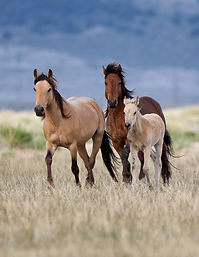

Wild Horses (mustangs)
When you see wild horses, what words come to mind?
Beauty, strength, curiosity, intelligence, freedom, resilience, strong family bonds.
Background
-
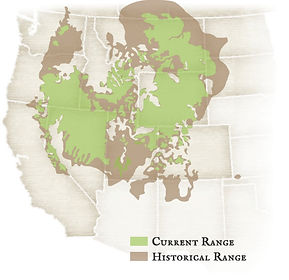
During the early 1900s, nearly 2 million mustangs roamed the American West (Fern, 2019).
-
Their population declined to less than 27,000 during the mid 1900s, after decades of brutal roundups and slaughter.
-
Today, their population is less than 81,000.
-
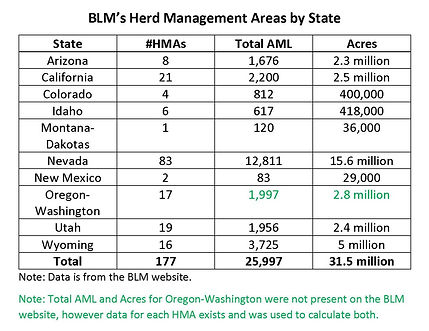
The Bureau of Land Management (BLM) and their 13 signatories on The Path Forward (2019), want their population down to 25,997 (see Table 1. Total AML).
-
Why?
-
View this amazing Video from the American Wild Horse Conservation (AWHC) for more background info:

Velma Johnston, Hero (1912-1977)
-
During the mid 1900s, Velma Johnston aka (Wild Horse Annie), courageously fought for their protection.
-
She successfully navigated all levels of government to get laws passed.
-
She also galvanized thousands of children across the USA to write letters, "pencil brigade" to their legislators (Fern, 2019).
-
One of her students (Tracey Fern), is the author of this Children's Book, "Wild Horse Annie: Friend of the Mustangs."
-
Thanks to Velma Johnston, her students, and many others' tireless work, a federal law was passed to protect them.
-
Do you think they are heroes?


Wild Free-Roaming Horses and Burros Act
-
In 1971, Congress unanimously passed the Wild Free-Roaming Horses and Burros Act (American Wild Horse Conservation, AWHC)
-
This federal law protects wild horses and burros from "capture, branding, harrassment, and death."
-
In addition, this law declares them as "living symbols of the historic and pioneer spirit of the West; that they contribute to the diversity of life forms within the Nation and enrich the lives of American people; and that these horses and burros are fast disappearing from the American scene." https://americanwildhorse.org/issue

Bureau of Land Management (BLM)
-
BLM, an agency within the U.S. Department of Interior, is charged with protecting and managing these animals on public lands.
-
The land was to be "devoted principally but not exclusively to their welfare in keeping with the multiple-use management concept of public lands," (NRC, 2013, p. 1).
-
Managing the land for multiple uses includes: recreation, mining, forestry, grazing of livestock, and habitat for wild ungulated and other species (NRC, 2013, p. 1).
-
Lastly, management was to "achieve and maintain a thriving natural ecological balance on the public lands," protect wildlife habitat, and prevent range deterioration (NRC, 2013, p. 1).
BLM Wild Horse & Burro Program
HMAs and AMLs (a closer look)
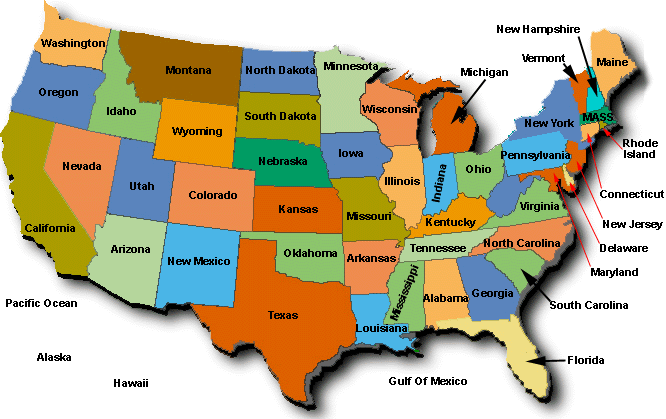
The BLM manages wild horses and burros in 177 Herd Management Areas (HMAs) across 10 western states (see Table 1). These areas are specifically designated for only horses and burros, however, BLM has their own agenda...more on that later.
-
Each HMA is unique in its terrain features, local climate and natural resources, just as each herd is unique in its history, genetic heritage, coloring and size distribution https://www.blm.gov/programs/wild-horse-and-burro/herd-management/herd-management-areas)
-
BLM manages herds within population-size ranges it deems Appropriate Management Levels (AMLs) (NRC, 2013).
-
AMLs are defined by the BLM as the point at which wild horse and burro populations are consistent with the land’s capacity to support them and other mandated uses of those lands, including protecting ecological processes and habitat for wildlife and livestock https://www.blm.gov/programs/wild-horse-and-burro/herd-management/maintaining-range-and-herd-health).
-
To take a closer look at HMAs simply Google Bureau of Land Management, click on Programs tab, then choose Wild Horse and Burro, then click on Herd Management Areas, then click on Herd Management Areas again, then choose a State, then choose a particular HMA within the state. The AMLs are listed in the text.
-
To better understand HMAs and AMLs, let's look at Table 1. (compiled by us).
Table 1. above shows how many herd management areas (HMAs) there are per state (10 Western states) and how many wild horses and burros BLM allows (AML) per state.
Notice how the Total AML for all 10 states is 25,997. BLM has purposely set the maximum wild horse and burro population below 27,000. If the wild population exceeds this number (and this can happen due to careless, over inflated census reporting by range managers) BLM announces an emergency round up due to 'over population'.
All of this will be revealed as you read ahead. For now, let's look at the Total AML's for some chosen states to understand the numbers.
-
For example, California has 21 herd management areas.
-
BLM allows only 2,200 wild horses and burros on 2.5 million acres of land.
-
Does that sound like a small number of wild horses and burros allowed on so much land?
-
Let's look at the percentage.
-
If we divide 2,200/2.5 million, that's 0.00088 wild horses and burros; which is basically nonexistent.
-
0.00088 x 100 = 0.088%
-
If we round up to the nearest tenth, that's 0.1%
-
So, BLM allows only 0.1% wild horses and burros on 2.5 million acres of land in California.
-
That's only a tenth (1/10) of 1 percent!
-
Let's look at one HMA in California:
-
The Centennial HMA is allowed only 134-168 (on average 151) wild horses and burros on 318,499 acres.
-
That seems like such an incredibly low population.
-
With such low numbers, doesn't that jeopardize the genetic viability of the wild horses and burros within this HMA?
-
According to Craig C. Downer (ecologist), populations should be over 1000 to be genetically sound.
-
Genetically sound means there is enough diversity within the herd to prevent birth defects (deformities).
-
https://www.horsetalk.co.nz/2021/08/22/outrageous-treatment-americas-wild-horses-habitat/
-
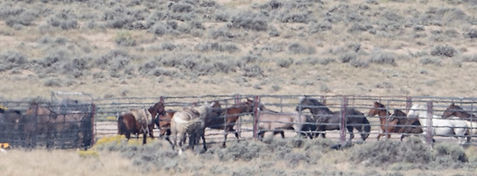
On top of this, the Centennial HMA appears to overlap on military land (see map).
-
Do you think it is safe for wild horses/burros to live on an HMA that overlaps with a military range?
-
Let's look at other states:
-
Arizona: BLM allows only 1,676 wild horses and burros on 2.3 million acres.
- That's 0.00073 x 100 = 0.073%, round to the nearest tenth
-
So, BLM allows only 0.1% wild horses and burros on 2.3 million acres in Arizona.
-
Let's look at one HMA in Arizona:
-
The Cerbat Mountains HMA is allowed only 72-90 (on average 81) wild horses and burros on 83,000 acres of land.
-
Again, 81 is far less than 1000; the number needed for a genetically sound herd.
-
Perhaps this is why the Spanish Colonial mustang is almost gone (Craig C. Downer).
-
For more information, click on link under photo.
-
-
Colorado: BLM allows only 812 wild horses and burros on 400,00 acres.
-
That's 0.00203 x 100 = 0.203 %, round to nearest tenth
-
So, BLM allows only 0.2% wild horses and burros on 400,000 acres in Colorado.
-
Let's look at one HMA in Colorado:
-
The Sand Wash Basin HMA is allowed only 163-363 (on average 263) wild horses and burros on 157,730 acres of land.
-
Again, 263 is far below 1000, the number needed to ensure a healthy (genetically viable) sustainable herd.
-
-
Oregon-Washington: BLM allows only 1,997 wild horses and burros on 2.8 million acres.
-
That's 0.00071 x 100 = 0.071%, round to the nearest tenth
-
So, BLM allows only 0.1% wild horses and burros on 2.8 million acres in Oregon-Washington.
-
Let's look at one HMA in Oregon:
-
The Barren Valley Complex consists of 3 HMAs: Coyote Lake/Alvord Tule Springs, Sheephead/Heath Creek, and Sand Springs Herd (see Table 1.5 below).
-
This complex allows only 459-892 (on average 676) wild horses and burros on 946,127 acres.
-
Again, 676 is far less than 1000.
-
-
Do you see a pattern here? Look at the average AMLs in Table 1.5. What do you notice? They are all far less than 1000. Why would BLM set such low AMLs?
-
Check the remaining states and choose one HMA in each state. Please share your results with us; we'd love to hear what you discovered.
-
Let's look at the definition of AMLs again:
-
BLM defines AMLs as the point at which wild horse and burro populations are consistent with the land’s capacity to support them and other mandated uses of those lands, including protecting ecological processes and habitat for wildlife and livestock (BLM website).
-
So, according to BLM, the land's capacity can only support a population of 0.1% to 0.2% wild horses and burros on Herd Management Areas (HMAs).
-
That's absurd.
-
Why so miniscule?
-
And why are the average AMLs for each HMA far below 1000?
-
After all, the Wild Free-Roaming Horses and Burros Act states that BLM is to protect, manage, and be devoted principally to the welfare of wild horses/burros.
-
Surely BLM wants to ensure each herd maintains genetic viability, but if that were true, why have they established such low AML's for each herd in the HMA's?
-
Keep reading to find out...
-
Table 1.

Table 1.5


HMA, Centennial Herd Area, CA
overlaps on a military range

Spanish mustangs in the Cerbat HMA in Arizona. Spanish mustangs, the subject of a report by Craig on his website. © Craig C Downer

Sand Wash Basin, Colorado
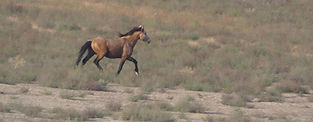
HMA, Sand Springs Oregon
BLM criticized
-
BLM has been subject to sharp criticism for their misinformation and mismanagement of wild horses, burros, and the ecological balance of the rangelands (NRC, 2013).
-
As a result, they asked the National Research Council (NRC), a committee of 14 scientists, to review their Wild Horse and Burro program.
-
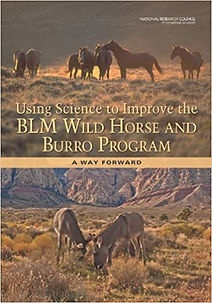
The NRC reviewed their program and published a book, Using Science to Improve the BLM Wild Horse and Burro program: A Way Forward (2013).
-
The NRC (2013) provided feedback to the BLM (see BLM misinformation below).
BLM misinformation
According to the NRC (2013):
-
How AMLs (Appropriate Management Levels) are established, monitored, and adjusted is not transparent to stakeholders, not supported by scientific information, or not amendable to adaptation with new information and environmental and social change (NRC, 2013, p. 11).
-
In addition: The links between the statistics on the national population size and the actual population surveys are obscure, i.e., the product of hundreds of subjective, probably independent judgements and assumptions by range managers...(NRC, 2013, p. 5).
-
It's important to note that these surveys establish the population size of each HMA within each state (10 Western states).
-
The HMA populations for each state are added up to create the national population.
-
BLM claims the current national population size of wild horses and burros is 81,951 (2019).
-
They claim this is 3 times greater than their nationwide AML goal of 26,690 (The Path Forward, 2019, p. 3).
-
BLM uses AML as justification for brutal roundups (see Roundups, Case Study 1 & 2).
-
-

BLM mismanagement
Disproportionate Land Distribution
-
Let's take a broader look at how BLM manages OUR public land.
-
BLM manages 245 million acres of our public land.
-
Ranchers are permitted to graze 63% at a fraction of the going rate ($1.35 per month for a cow/calf pair or 5 sheep since 1986 to now; cattle ranchers have a $100 million-plus deficit, and taxpayers (unknowingly) are subsidizing (paying) for this deficit (https://insideclimatenews.org/news/25072022/the-bureau-of-land-management-lets-1-5-million-cattle-graze-on-federal-land-for-almost-nothing-but-the-cost-to-the-climate-could-be-high/) and (AWHC https://americanwildhorse.org/problem).
-
Wild horses and burros are authorized to roam on 17% (HMAs), however they are only present on 12% of BLM-managed public land (AWHC website).
-
Wild horses and burros must share their land with livestock (hence the red lines over 12% HMA on pie-chart).
-
Huh?
-
So livestock are grazing on 75% of OUR public land!
-
Why are livestock allowed to graze in HMAs (land specifically reserved for wild horses and burros)?
-
Based on this pie-chart, it appears that the land is disproportionately supporting livestock (cattle and sheep) RATHER than wild horses and burros.
-
Does that sound fair to you?
-
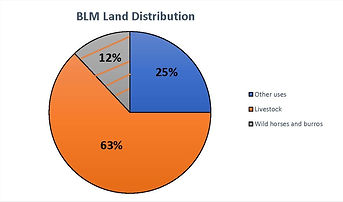
Figure 1.
Ratio (Cattle : Horses/Burros)
-
According to Public Employees for Environmental Responsibility (PEER), cows outnumber wild horses on BLM lands by a ratio of more than 30 to 1.
-
With an estimated 81,000 (2019) wild horses and burros, that means there are over 2 million cows grazing on OUR public lands!
-
This number may be even higher according to Holly Gann Bice (AWHC).
-
She claims over several million privately owned commercial livestock are permitted to graze on BLM public lands. That's because millions of sheep also graze on OUR public lands.
-
Hmmm, this is why BLM created such low AMLs for wild horses and burros? So that the land's capacity supports millions of livestock instead!
-
But what effect does this have on OUR public land's ecological processes and habitat for wildlife?
-
Table 2. below provides a visual of how ratios work...

Figure 2.
The white dots represent cows, and the black dot represents the horse. The red lines represent cows grazing in HMAs (Herd Management Areas for wild horses and burros).

Forage allocation
-
As already discussed, BLM seeks to reduce wild horse and burro populations down to 27,000 animals (AWHC website).
-
This number is based on the allocation of 80% of forage (food) in wild horse and burro habitat (HMAs) goes to privately-owned commercial cattle and sheep.
-
What?!?
-
Yes, you read that right.
-
BLM establishes their AMLs for wild horses and burros to miniscule numbers so that livestock can get a disproportionately larger share of forage (food).
-
On top of this, tax payers spend millions of dollars to subsidize their livestock grazing (AWHC).
-
Is that how you want your tax dollars spent?
https://americanwildhorse.org/issue
Winners & Losers
-
Who's winning here?
-
The cattle ranchers, livestock (cattle and sheep), and BLM.
-
-
Who's losing here?
-
Wild horses, burros, and US (the American people).
-
-
Truth be told!
-
Tell your parents, legal guardians, family members, friends, etc. and let them know how their tax dollars are being spent.

Figure 3.

HMA, Cerbat North-West Arizona, over-grazed by cattle. This HMA was once famed for its Spanish Colonial mustang which are almost gone (Craig C. Downer).
Effects of BLM mismanagement
We have already discussed the disproportionately large amount of land (75%) and forage (80%) BLM allocates for livestock, but what about the effects of this on rangeland health and wildlife habitat?
-
According to Public Employees for Environmental Responsibility (PEER), "On the majority of lands where the agency (BLM) has identified wild horses as implicated in the decline of sage grouse habitat, agency records indicate livestock grazing as a significant cause of habitat degradation" (Stade, 2021, p. 1).
-
What are sage grouse and why would BLM blame wild horses for the deterioration of their habitat?
-
Let's answer the first question now, and the latter later.
-
Sage grouse are a type of bird.
-
There are two species: the greater sage-grouse (including the geographically distinct BI-State population on the California/Nevada border) and Gunnison sage-grouse.
-
Habitat: Vast, intact landscapes dominated by sagebrush and grassland.
-
Food: Sagebrush leaves (entirely in winter), other plant leaves, stems and buds; and insects.
-
Nests & Chicks: Hens lay an average 6-9 eggs in a ground nest hidden under sagebrush. Chicks are downy at birth and ready to run after their mother.
-
Conservation: Numbers are declining, largely due to habitat loss.
-
View is amazing educational resources with maps and sounds:
-
https://www.allaboutbirds.org/guide/Greater_Sage-Grouse/overview#
-
Finally, why would BLM blame wild horses for the degradation of the greater sage-grouse habitat?
-
Why do you think?
-
They use wild horses as a 'scapegoat' for the root cause of greater sage-grouse habitat loss, which is really livestock overgrazing (Spade, 2021, p. 2).
-
In sum, it is overwhelmingly apparent that BLM's deliberate obfuscation of livestock eco-impacts is a function of political pressure from the ranching industry (Stade, 2021, p. 1-2).
-
Obfuscation means: the action of making something obscure, unclear, or unintelligible.
-
Lastly, it is clear that BLM is not fulfilling their mandated responsibility to "achieve and maintain a thriving natural ecological balance on the public lands," protect wildlife habitat, and prevent range deterioration (NRC, 2013, p. 1).
-
https://peer.org/interior-wild-horse-focus-ignores-cattle-impacts/


Horses blamed (scapegoat)
What is a scapegoat?
-
Scapegoat theory refers to the tendency to blame someone else for one's own problems, a process that often results in feelings of prejudice toward the person or group that one is blaming.
-
Scapegoating serves as an opportunity to explain failure or misdeeds, while maintaining one's positive self-image.
-
So, based on this definition, BLM scapegoats wild horses and burros for land degradation, when the real culprits are livestock, in order to protect the cattle industry's image.
-
"Behavior is the mirror in which everyone shows their image." -Goethe

The REAL Culprits (evidence)
Commercial livestock ranchers often site the wild horse population as the root cause of resource depletion and landscape deterioration (AWHC).
Let's examine who the real culprits are using evidence from reputable sources.
Resource depletion (forage)

-
As you can see from Table 3., each cow consumes 6 times more forage than one horse. Note: Burros eat 1/2 as much as horses.
-
Looking at the ratio, cattle consume 195 times more forage than horses.
-
Because cows eat anything and move very little, they can completely decimate the vegetation in a small area.
-
With millions of cattle on OUR public lands, their overgrazing can cause irreparable damage to the rangeland, thus causing severe habitat loss for wildlife, such as the greater sage-grouse.
-
Note: Millions of sheep also graze OUR public lands.
-
If we include them, the actual ratio of livestock (cattle and sheep) to horses is 50:1 (Farley, 2015, Introduction).
Resource depletion (water)

-
As you can see from Table 4., each cow consumes twice as much water than a horse on a cold day, and 4 times as much water on a hot day.
-
Looking at the ratio, cattle consume hundreds to thousands of gallons of water MORE than horses do.
-
Thus, based on the evidence in these two tables, it is clear that wild horses are not the root cause of resource depletion.
-
Rather, the real culprits are the cattle ranchers' livestock (cattle and sheep).
-
https://www.hanaeleh.org/horses-versus-cattle-truth-behind-grazing-rights/

Landscape deterioration
-
According to PEER, most of the allotments within HMAs that fail its standards for rangeland health identify livestock as a significant cause of that failure.
-
Livestock are by far the most frequently identified cause of allotment failure to meet standards for: quality of water, vegetation, and soils, as well as the ability to support wildlife nationwide, including for allotments with HMAs (Stade, 2021, p. 2).
-
Let's look at Table 5. and contrast how livestock negatively impact rangeland health, whereas horses positively enrich and balance rangeland health.


-
As you can see from Table 5., cattle are the real culprit with regard to land deterioration. Even more, they contribute to climate change and devastating forest fires.
-
Check out these references for a closer look:
-
https://www.horsetalk.co.nz/2021/07/17/horses-carbon-sequesters/
-
Biden announces global goal to reduce planet-warming methane emissions - CNN
-

-
Genetic evidence (video):
-
Case study (Land deterioration)
Let's look at a specific example of how cattle can devastate ecological processes and habitat for wildlife.
-
The Pando Aspen Grove, in Southern Utah, is believed to be the most massive living organism in the world.
-
However, every fall, about a thousand cattle pass through for a week or two on their way to winter pastures.
-
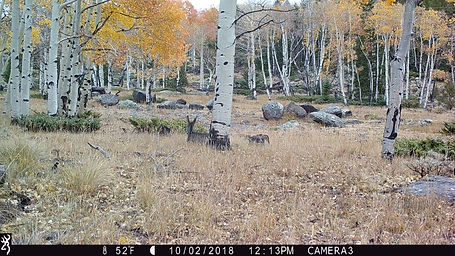
During the herd’s brief stay, up to 90% of the plant growth beneath the trees in the unfenced portions of the grove is grazed away (see before and after pictures).

-
These photos were taken by the Western Watersheds Project to provide evidence since the Forest Service blamed mule deer, another scapegoat, for the real culprit (cattle).
-
According to an ecologist (John Carter), aspen and mule deer have been sharing the landscape for thousands of years, evolving with each other.
-
“It is counterintuitive," Carter said, “that mule deer would be causing the dieback that we’re seeing at the Pando clone, and in many other parts of the West."
-
It is only since the arrival of domestic livestock that the West’s aspens have begun disappearing, replaced by conifers.
-
The Western Watershed Project has advised the Forest Service to do its job and remove the cattle for five years and measure the results.
-
To find out what the Forest Service has done, you can contact them here: https://www.fs.usda.gov/
-
Let us know what you found out.
-
Here is a link to the full article below:
-
https://www.sltrib.com/news/environment/2019/07/04/whats-killing-worlds-most/
Roundups
What are roundups?
-
BLM refers to roundups as gathers.
-
They claim they are necessary during emergency conditions.
-
Let's examine an argument from Nada Wolff Culver, BLM Deputy Director, Policy and Programs states.
-
"As one of the agencies charged with the responsibility to protect and manage America's wild horses and burros, the BLM is prepared to take emergency action where we can in order to save the lives of these cherished animals. At the same time, we are committed to continuing our efforts to reduce overpopulation across the West and achieve healthy, sustainable herd sizes that are more capable of withstanding severe conditions, including prolonged drought, which are becoming more frequent due to climate change."
-
Yes, BLM is charged with the responsibility of protecting and managing American's wild horses and burros, but are they?
-
We have already revealed how they use misinformation (AMLs) which are not based on scientific information, to keep wild horse and burro populations at miniscule numbers so that 80% of the forage on HMAs (land reserved for horses and burros) is allocated to livestock.
-
She says they are committed to reducing the overpopulation of wild horses and burros to achieve healthy, sustainable herd sizes.
-
What overpopulation? We have already discovered that the wild horse and burro population is only 0.1% to 0.2% and that the average ALMs at each HMA are well below 1000; the number needed for genetically diverse and viable populations in order to prevent birth defects (deformities).
-
The overpopulation she fails to mention is LIVESTOCK. We have already discussed the ratio of cattle to horse is 30:1. Notice how she doesn't mention anything about the overpopulation of livestock, i.e., millions that overgraze our public lands?
-
Yes, we are in a drought, but notice how she doesn't mention that cattle drink hundreds to thousands of gallons more water than horses?
-
Notice how she doesn't mention that cattle contribute to climate change due to their production of methane (a greenhouse gas which traps 25 times more heat than carbon dioxide)?
-
So, you can see that her argument is debunked by the evidence (facts) we have already explored thus far.
-
Now, let's look at her language. She says, "BLM is prepared to take emergency action where we can in order to save the lives of these cherished animals.
-
Are they saving wild horses and burros lives, or are they endangering them?
-
To find out, let's look at the effects of roundups.
-
WARNING, if you are sensitive to issues of abuse, you may want to skip this next section.



Effects of BLM Roundups

BLM uses the word gathers instead of roundups. This word (gathers) is really a euphemism to disguise the brutality which occurs during these 'emergency' events.
-
A euphemism is a mild or indirect word or expression substituted for one considered to be too harsh or blunt when referring to something unpleasant or embarrassing.
What happens during a roundup?
-
BLM announces a gather for the following reasons: lack of food/water, overpopulation, land degradation, drought, fire risk, climate change, nuisance, etc.
-
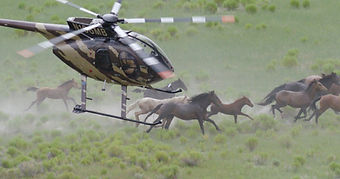
They hire a contractor who uses a helicopter to chase wild horses and burros into pens (traps).
-
Some contractors use their helicopter as a weapon, harassing and even hitting horses (see photo), thus causing severe injury and death.
-
They also target one family group at a time, knowing the wild horses will stay together.
-
Horses have incredibly strong family bonds; they are loyal, devoted, and protective of each other.
-
As the wild horses and burros stampede through the narrow pens, many get injured (trampled, kicked, crushed, etc.,).
-
This causes severe stress, injury, and death.
-
Family members get separated which causes distress and trauma.
-
Foals get separated from their mothers.
-
Listen to an eye-witness account of what actually happens during a roundup:
-
"It's inhumane. The families are separated, the moms are crying for the babies, the babies are crying for the mom, the stallions are crying for their families. It's an old tool and it needs to go away," (Deb Walker, AWHC).
-
Not only is it inhumane, but it's against the law, according to the Wild Free-Roaming Horses and Burros Act. This federal law protects wild horses and burros from "capture, branding, harrassment, and death," (AWHC, website, The Issue).
Case Study 1:
Colorado (Sand Wash Basin, September 2021)
-
Sand Wash Basin iconic herd known all over the world.
-
This is Picasso; the most photographed wild horse in the world.
-
Although he disappeared in 2019, he has/had offspring, a son Van Gogh (this will be discussed later).
-
BLM claims this roundup was an 'emergency' due to lack of food/water to sustain the wild horses
-
Wild horse population was 896 on 157,730 acres
-
AML 163-362
-
1000+ sheep graze within the HMA at $1.35 per animal per month subsidized by taxpayers
-
528 wild horses captured; 49 returned
-
Total removed: 479
-
Roundup occurred over several days (~7 hours each day) in 95 degree heat
-
Wild horses within the HMA were chased to exhaustion, 10+ miles into traps
-
6 foals were unable to keep up and got separated from their mothers
-
5 foals were left alone on the range (how are they suppose to get nourishment w/o their mothers?)
-
1 six-month-old foal brought itself to the corrals with damage to all 4 legs - which the BLM classified as “pre-existing." BLM euthanized (killed) the foal.
-
According to AWHC, the contractor (Troy Cattoors) and the Colorado BLM did not take the time to set up three traps within the HMA. As a consequence of their supreme indifference and lack of concern for the welfare of the wild horses, they caused unnecessary suffering, distress, and death.
-
How will those 5 foals survive without their mothers?
-
Did the mother (mare) of the injured foal see BLM euthanize her baby?
-
Taxpayers, we the American people, paid $289,000 for this roundup!
-
-
This inhumane, blatant disregard for the safety and welfare of these wild horses runs counter to Nada Wolff Culver (BLM Deputy Director, Policy and Programs) proclamation of BLM's responsibility to protect, manage, and save the lives of these cherished animals.
-
To read the full article, click link below
-
https://americanwildhorsecampaign.org/media/roundup-report-sand-wash-basin-wild-horses-sept-2021
-
On top of this, 2 months after the roundup, BLM allowed 3,000+ sheep to graze in the Sand Wash Basin HMA.
-
What?
-
Didn't BLM say there wasn't enough food and water to sustain the wild horses?
-
According to Delia Malone, an ecologist from the Sierra Club, Colorado Chapter, “Under the guise of ‘severe drought,’ the BLM conducted a helicopter roundup and removal of wild horses from their legally designated Herd Management Area. Now, they’ve permitted thousands of domestic sheep to exacerbate the supposed impact on the vegetation of Sand Wash Basin, vegetation that is legally prioritized for wild horses."
-
She also states, "BLM’s purported concern for wild horses being harmed by the climate-warming induced drought was nothing more than a ruse to provide the livestock industry with more (almost) free grazing on our public lands. Wild horses, not private domestic livestock, belong on our public lands.”
-
This case study provides another example of BLM's business as usual, i.e., using misinformation (lies) and prioritizing livestock grazing.
-
Let's go back to the law.
-
The law states that BLM is charged with protecting and managing wild horses and that the land was to be "devoted principally but not exclusively to their welfare in keeping with the multiple-use management concept of public lands," (NRC, 2013, p. 1).
-
Yet, we have unveiled evidence which demonstrates that BLM is NOT devoting the land principally to the welfare of wild horses, but rather to livestock.
-
If there was a shortage of food and water, which was their justification for the roundup, then why release 3,000+ sheep?
-
On top of this, BLM turned out another 2,500+ sheep for a total of 5,500+ sheep to graze from the Sand Wash Basin HMA (Colorado) to Wyoming over the course of 6 months (Nov-May).
-
This mass migration grazed right through Greater sage-grouse habitat (see map).
-
Apparently, Colorado BLM did NOT prioritize the greater sage-grouse's declining status (see hunter sign) nor the health of the rangeland.
-
Unfortunately, this is another example of BLM NOT fulfilling their mandated responsibility to "achieve and maintain a thriving natural ecological balance on the public lands," protect wildlife habitat, and prevent range deterioration (NRC, 2013, p. 1).
-
Isn't this breaking the law, i.e., BLM's mandate to the multiple-use management concept of public lands?
-
And using misinformation (lies) to serve their agenda and/or the agenda of the cattle industry?
-
According to Scott Wilson, Denver-based wildlife photographer and member of the AWHC's board of directors, “It is unconscionable to invite hordes of commercial livestock to fatten up on public lands where Colorado’s wild mustang population has been decimated in the name of drought and forage protection. This is business, not conservation."
-
This roundup of an iconic wild horse herd did not have to happen, but it did, and will continue, unless WE speak out against the BLM and their partial partnership with the cattle industry.
-
The evidence is clear; pictures don't lie.
-
Look at these photos. Does this look like a water shortage to you?
-
Lastly, Picasso's son, Van Gogh, was tragically hit by a car and killed on Highway 318 October 2020. Horse advocates had urged the Colorado Department of Transportation (CDOT) to put up fencing along the highway to protect both wild horses and drivers, but they failed to do so. You can investigate yourself to see if they have finally done so. (970) 243-2368






According to Kirsten Stade:
-
In Colorado, the Sand Wash Basin wild horse roundup, the largest wild horse roundup in the state’s history, overlaps portions of ten grazing allotments totaling 158,000 acres where BLM assessments have overwhelmingly found livestock-and not wild horses- to be at fault for deteriorated range conditions (PEER Press Release, 9-20-21).

Van Gogh 2014-2020
Rest in peace
Case Study 2:
Oregon (Barren Valley Complex, September 2021)
-
BLM claims this roundup was an 'emergency' due to excessive horse population; exceptional drought; and lack of forage.
-
June 2021, BLM claims ~ 2,500 wild horses were counted in the complex on nearly 1 million acres (who did the count and were they accurate or purposely inflated the numbers?)
-
AML 459-892
-
1,672 wild horses were captured
-
27 deaths
-
Roundup duration: September-November (48 days)
-
AWHC group's observer documented multiple instances of inhumane treatment:
-
Using high voltage electric shock cattle prods on horses
-
Forcibly pulling a stallion into a trailer by tying him to the saddles of 2 domestic horses
-
Knocking a foal to the ground by roping the baby horse from horseback
-
6 deaths in the first 5 days of the operation
-
-
The following quotes are from Suzanne Roy (Executive Director of AWHC):
-
"Wild horses are being euthanized at alarming rates, young foals are being stampeded by helicopters and left out on the range without their mothers, and the agency (BLM) is now using high-voltage cattle prods to electroshock wild horses as a handling tool."
-
"BLM aims to reduce the wild horse population down to 459 while allowing 1,100 cow/calf pair to graze year round in the complex."
-
That's 2,200 individual cows, 5 times more than wild horses!
-
We have already discussed how each cow consumes 6 times as much forage than one horse.
-
"The agency (BLM) fails to address the root cause of land degradation and harm to wildlife, which is the extensive cattle and sheep grazing authorized in wild horse habitat areas (HMAs)."
-
Sound familiar to you?
-
"It's time for Congress to hold an oversight hearing on the scientific, environmental, humane, and fiscal problems associated with this mismanaged federal program."
-
To read the full article, click on the link below
-
Warning:
-
Video of abuse, click the link below. The word video is interwoven throughout the text; there are many videos.
-
BLM hired a contractor, Sun J Livestock of Vernal, Utah to conduct the roundup.
-
Notice the word livestock in the contractor's name? Is that why they treated the wild horses like cattle, i.e., using high voltage electric shock cattle prods during the roundup?
-
Do they not know the difference between cattle and wild horses?
-
Does this sound humane to you?
-
Does knocking down a foal to the ground and leaving several alone on the range without their mothers sound humane to you?
-
Does forcing a stallion onto a trailer with two domestic horses, one on each side, sound humane to you?
-
Does 27 deaths sound humane to you?
-
Taxpayers, WE the American people, paid $488,000 for this roundup!
In Sum:
-
It is clear that BLM is not upholding the law, i.e., what the Wild Free-Roaming Horses and Burros Act states.
-
Do you remember?
-
This federal law protects wild horses and burros from "capture, branding, harrassment, and death," (AWHC, website, The Issue).
-
However, in both Roundup Case Studies, there is clear evidence of capture, harrassment, and death.
-
In both cases, BLM used misinformation (lies) that it was an 'emergency' to gather wild horses due to their overpopulation and lack of food/water caused by severe drought.
-
In both cases, livestock were allowed to remain in the wild horse and burro management areas (HMAs) to consume forage and water even though BLM said their wasn't enough to sustain the wild horses.
-
In both cases, the number of livestock outnumber wild horses by the hundreds of thousands, even millions, i.e., wild horses/burros ~81,000 versus livestock (~2 million cattle + several million sheep) (Craig C. Downer, 2021).
-
In both cases, eye witnesses reported that the body condition of the wild horses was good, i.e., not needing emergency intervention as BLM claimed.
-
So why is BLM getting away with clearly breaking the law?
-
Because, under pressure from special interests, the federal agency (BLM) has turned the law on its head, committing the very atrocities Congress sought to protect mustangs against (AWHC).
-
Can you guess who the special interest groups are?
-
You guessed it. The cattle industry appears to be the main culprit, but there are others...read on to find out...


Uhhh hello BLM... don't you know the difference between horses and cattle? If so, then why are you treating horses like cows? Are you confused like the livestock contractors you hire for roundups?
Once removed, what is their fate?
Once removed, wild horses and burros have lost their Freedom and Family, the two most important things to them.
What happens next?
-
They are trucked to holding facilities:
-
Holding facilities range from long-term pastures (where they are separated by gender); short-term holding pens (waiting to be either sold or adopted); or warehoused in long-term facilities (AWHC).
-
For example, the wild horses from Roundup Case Study 1 (Colorado, Sand Wash Basin, the iconic herd known all over the world) wound up at the East Canon Correctional Complex (prison) in Colorado). And not just any prison; a supermax prison.
-
How is this possible you may ask? Do they deserve this fate?
Read the description below:
EAST CANON CORRECTIONAL COMPLEX, COLORADO: A cluster of six State facilities east of Canon City, which includes the Four Mile Correctional Facility, Colorado State Penitentiary, Centennial Correctional Facility, Arrowhead Correctional Center, Skyline Correctional Facility, and the Fremont Correctional Facility. These, along with the nearby Florence Corrections Complex (a cluster of four federal prisons, including USP Florence ADMAX, a notorious "supermax" facility), make this valley in Colorado the largest concentration of correctional facilities in the nation.
-
This is a "temporary" facility, but captive horses have been languishing there for almost a year, if not longer.
-
Look closely at the horses in this photo (click link below).
-
https://www.flickr.com/photos/blmcolorado/51607625008/in/album-72157720045710306/
-
What do you notice?
-
I see horses crowded in pens like cattle. I see horses standing around with nothing to do. I see ribs showing on some of the horses. I see the effects of captivity (sadness, helplessness, hopelessness, and suffering) in some of the horses eyes.
-
In addition, do you see any shelter or water troughs in this picture? Especially when it's hot; the horses need shade and water.
-
2,950 wild horses are at this complex.
-
4 state employees and 22 inmates handle the horses under BLM supervision.
-
26 total handle and care for almost 3,000 horses.
-
That's 113 per person!
-
Does that sound like enough workforce to properly take care of them?
-
As of May 2022, 142 horses have died from equine flu due to BLM's failure to provide vaccinations.
-
"Humane treatment at holding facilities should include prompt vaccinations of captive horses as soon as they settle after the trauma of relocation", said Cañon City veterinarian Pam Rose.
-
"Concentrating 2,550 horses in fenced pens “is not natural,” Rose said.
-
Read the report here and watch Video:
-
https://www.denverpost.com/2022/05/12/wild-horses-die-unvaccinated-blm/
-
All 479 of the wild horses from the Sand Wash Basin roundup in September 2021 were taken to the East Cannon Correctional Facility (Roundup Case Study 1).
-
Carol Walker, renowned wild horse photographer, has photographed these horses for 5 years and knows them by name.
-
When she went to visit them, she observed deplorable conditions:
-
"I was horrified," Walker said. "There was mud, muck, and urine, like ankle deep, there was not much hay, and when I went to the yearling pen... half of them were skin and bones, including my little guy that I adopted."
-
"To see these horses that I love and know and that I've been following for five years, in this condition was just, it was horrendous," Walker said.
-
“This is an animal welfare and animal cruelty issue,” Walker said. “You put a whole bunch of horses in a small area. They get stressed. They get sick. And now, with all these horses dying and sick, you’re going to go gather another 1,000 horses and put them in this crowded facility?”
-
See Video:
-
While visiting, she adopted a horse she had photographed back in 2016 with his mother on a range in Wyoming.
-
Since being roundup, she discovered he was at the East Canon prison facility.
-
She named him Helios (look at before and after photos).


Wild horses from the September 2021 Sand Wash Basin roundup. (credit: Mark Neitro, CBS4)

Helios with his mother on a range in Wyoming before being roundup October 2016

Helios at the East Canon prison August 2021
-
In the first photo, Helios looks happy and healthy with his mother before being roundup.
-
Contrast this photo with Helios at the East Canon prison. He looks incredibly sad (having lost his mother) and his ribs are showing, clearly not getting enough food.
-
In Sum, 479 of OUR nation's most iconic wild horses went to a prison complex which includes a "supermax" facility.
-
Is this safe for the horses?
-
Are the inmates who 'care' for the wild horses screened for animal abuse, domestic abuse, etc., and monitored at all times when they are with the horses?
-
Are there cameras to watch their behavior around the horses as well?
-
BLM estimates it spends more than $3 million in federal taxpayer money a year 'caring' for the horses in Cañon City!
-
TRUTH BE TOLD!
-
Tell your parents, legal guardians, aunts, uncles, cousins, friends, etc., that BLM is spending $3 million of OUR taxpayer dollars to severely neglect and cause death to the wild horses being held captive at a prison in East Canon Correctional Facility in Colorado.
-
Not only has BLM striped these wild horses of their freedom, but they have incarcerated them like prisoners.
-
These horses are not criminals!
-
They don't belong in a prison; they belong in the wild!
-
We must act NOW. We must speak up NOW. Go to the TAKE ACTION tab to learn how.
-
"Indifference to me, is the epitome of evil..."
-Elie Wiesel
Shining a Light on TRUTH


-
BLM sold nearly 1,800 wild horses to Tom Davis (2008-2012), a rancher and livestock hauler in La Jara, Colorado.
-
He is the nation's largest buyer of wild horses.
-
He sold all of them to kill buyers in Mexico where they were brutally slaughtered.
-
https://www.denverpost.com/2015/10/23/federal-report-colorado-wild-horse-buyer-sold-mustangs-for-slaughter/
-
701 of the 1800 horses came from the East Canon prison in Colorado (see list below).
-
.


-
Federal and state authorities in Colorado declined to prosecute Davis for his actions.
-
NO accountability, NO prosecution for him or BLM.
-
How is this possible, especially with incriminating evidence (emails)?!?
-
This is an EXTREME case of the BLM and Colorado state authorities breaking a federal law (Wild Free-Roaming Horses and Burros Act) which "protects wild horses and burros from "capture, branding, harrassment, and death."
-
In this case, death.
-
What is the fate of the wild horses remaining at East Canon prison today?
-
What do you see in the eyes of this foal?
-
I see him/her asking for help.
-
What will you do to help?

A younger wild horse in a pen at the Cañon City prison complex. (credit: Mark Neitro, CBS4)
BLM's blatant mistreatment & animal cruelty
"Pictures speak a thousand words."
What do these pictures say to you?
These photos were take from the Kiger HMA located approximately 45 miles southeast of Burns, Oregon. HMA is 36,618 acres with an AML of 51-82.
Look closely at the pictures. Do you see blue and white spray paint on some of the horses? Is this a form of temporary 'branding' for sorting and categorizing purposes? Isn't this against the law?
Remember, the Wild Free-Roaming Horses and Burros Act passed by Congress in 1971, protects wild horses and burros from "capture, branding, harrassment, and death." These photographs, from their website, are evidence of their complete disregard for the welfare of wild horses; they treat them like disposable objects.
Furthermore, look at their body condition. Do they look malnourished? Do they look like they needed to be 'saved' from lack of food or water due to drought conditions out on the range?
This is the false argument (lie) BLM uses time and time again to justify 'emergency' roundups. To tear apart families and take away their right to freedom.
These wild horses probably went to long-term pastures where they are separated by gender (hence the blue and white spray paint).
In addition to long-term pastures, others stay in short-term holding pens, waiting to be either sold or adopted.
These wild horses are branded and hot-glued with bar codes. Again, they are treated like things (commodities) rather than sentient beings who deserve to be treated humanely.
Look into their eyes. What do you see?
“The greatness of humanity is not in being human, but in being humane.” -Gandhi
"I hold that the more helpless a creature, the more entitled it is to protection by man from the cruelty of man.” -Gandhi
(Photo Laura Leigh, Wild Horse Education)
Foals often get separated from their mother's during and after roundups. This foal was born in holding, separated from his mother, starved, and then euthanized by BLM.
Does that sound humane to you?
Horrifically, this was likely the same fate for the five foals left out on the range without their mothers after the Sand Wash Basin (Colorado) roundup in 2021), see Effects of BLM Roundups: Case Study 1.
Long term holding facilities are not only physically and psychologically inhumane for wild horses and burros, they also cost American taxpayers millions of dollars annually.
Is this how WE want OUR tax dollars to be spent? On cruelty and suffering? Currently, more than 53,000 horses and burros are stockpiled in permanent government warehouses (prisons) with more on the way due to current roundups!
Horses over ten wind up being trucked to slaughter. They are crammed in trailers under stressful conditions: extreme heat, no water, and/or food, and transported 30+ hours to Mexico and/or Canada where they are brutally slaughtered for human consumption in predominately Asian and European countries.
This is a billion-dollar industry, with 82% of Americans (who know about it) opposing it, yet 150,000 horses are slaughtered every year! What does this say about OUR country?
Some horses get adopted through BLM's guise of an adoption program (which is fraught with fraud and mal intent, i.e., giving $1,000 to adopters). Unfortunately, many horses are either severely neglected (adopters care more about obtaining the money than the horse) or ironically sold to auction houses where kill buyers purchase them for slaughter.
Pivotal players of this perpetual loop of misinformation (lies), brutal/deadly roundups, stockpiling wild horses, slaughter pipeline, and shipment of horse meat overseas involves BLM, US Forest Service, US Department of Agriculture, and special interests groups (cattle and sheep ranchers, the hunting establishment, agribusiness, developers, mining and energy companies, etc.). Here's the perpetual loop:
BLM posts a scheduled roundup on their website: https://www.blm.gov/programs/wild-horse-and-burro/herd-management/gathers-and-removals
Choose a state to see which HMA's will have roundups scheduled.
For example, Nevada has 3 scheduled roundups this summer:
2023 Antelope Complex-North Wild Horse Gather
2023 Antelope Complex-South Wild Horse Gather
2023 Reveille Herd Management Area Wild Horse Gather
For the purpose of brevity, let's explore the first roundup. It reads as follows:
Look at the language. What do you notice? The title contains the word 'gather' instead of roundup. Do you remember from an earlier section of this website (Effects of BLM Roundups) that BLM uses the word gathers instead of roundups as a euphemism to disguise the brutality of these 'emergency' events.
-
A euphemism is a mild or indirect word or expression substituted for one considered to be too harsh or blunt when referring to something unpleasant or embarrassing.
Next, check out the Details of Gather. What do you notice? They say they will utilize the services of a helicopter contractor to gather and remove up to 2,000 excess wild horses.
As already discussed previously, (Roundup Case Studies 1 & 2) BLM hired livestock companies who used excessive and deadly force. Hopefully, this will NOT be the case with this roundup.
In addition, notice the language BLM uses...to gather and remove up to 2,000 excess wild horses.
Remember, BLM has created and set forth Appropriate Management Levels (AMLs) for each Herd Management Area (HMA).
AMLs are just a fancy term they use to confuse the American people. Don't be fooled! AMLs are just the number of wild horses/burros BLM allows on each HMA.
This number is calculated in such a way so that the total population of wild horses/burros in all 10 states, on all 177 HMAs, does not exceed 25,997 (see Table 1 at the beginning of this website).
An excess to BLM means the cattle ranchers are complaining that their livestock are not getting 80% of the forage on HMAs (land that should be designated to only wild horses/burros, but is greedily shared by livestock (see Figures 1 & 3 at the beginning of this website).
Let's keep going and take a look at the Purpose of Gather. What do you notice? It says the purpose of the gather is to prevent undue or unnecessary degradation of the public lands associated with excess wild horses and to restore a thriving natural ecological balance.
We have already discussed previously who the real culprits are when it comes to land degradation. To summarize, the real culprits are livestock (cattle and sheep). There numbers (~2 million cows and several million sheep) far exceed ~81,000 wild horses and burros that graze on our public lands.
Do you remember Table 5? This table demonstrates the negative impacts of cattle versus the positive effects of wild horses/burros. In fact, wild horses and burros help restore a thriving natural ecological balance.
Furthermore, the Public Employees for Environmental Responsibility (PEER) obtained BLM's rangeland health data via the Freedom of Information Act, and discovered that its data reveal that most of the allotments within Wild Horse Herd Management Areas (HMAs) that fail its standards for rangeland health identify livestock as a significant cause of that failure (Stade, 2021, p. 2).
Lastly, livestock are by far the most frequently identified cause of allotment failure to meet standards for quality of water, vegetation, and soils, as well as the ability to support wildlife nationwide (Stade, 2021, p. 2).
Next, let's view the Adoption Information. What do you notice? It says that the horses will be transported to the Indian Lakes Facility, Fallon, Nevada where they are readied for the BLM Wild Horses and Burros Adoption Program. Lastly, it says that those horses that don't get adopted will live the rest of their lives on off range pastures.
When researching Indian Lakes Facility (Fallon), Nevada, it states that it is a privately owned/operated corral. Hmmm, by whom?
It also states that this facility can care for up to 7,600 wild horses and burros. How many wild horses/burros are there now? With 2,000 wild horses being round up, will there be enough space for them, and if not, where will they go?
https://www.blm.gov/press-release/blm-offers-public-tour-wild-horse-corral-fallon-0
Finally, let's look at the Background information. It says that as of March 2023, the population is estimated to be 6,852 which is 14 times above the low end of the established management level.
According the NRC (2013), actual population surveys are obscure, i.e., the product of hundreds of subjective, probably independent judgements and assumptions by range managers...(NRC, 2019, p. 5).
In addition, BLM's management levels, i.e., Appropriate Management Levels (AMLs) are not transparent to stakeholders, supported by scientific information, or amendable to adaptation with new information and environmental and social change (NRC, 2019, p. 11).
If we go the actual Antelope HMA data on BLM's website, the AML is 150-324. The low end of this AML is 150. Again, based on what we've learned previously, 150 is far below 1,000, the population size needed for genetically healthy herds.
So, in a nutshell, having taken each section of BLM's Roundup announcement (argument), we can see that it is deceptively flawed with lies. We know this because we have deconstructed it step-by-step and checked their information with facts from resources written by scientists.
Give yourself a pat on the back for hanging in there with me as I showed you how to critically analyze (question) and fact check a text of lies.
Now, we move onto the two other main players of egregious greed. The US Forest Service and the US Department of Agriculture.
The US Forest Service is actually a branch of the US Department of Agriculture. They manage national forests, grasslands, invasive species, etc., and restore natural resources (water, air, and soil). They also issue commercial permits to businesses (mining, oil, natural gas, cattle ranchers, etc.,) for land use. For a full description of their responsibilities, go to:
https://www.fs.usda.gov/managing-land
Yet, based on what we've learned previously (Case study: Land deterioration) the Forest Service permits thousands of cattle to pass through the Pando Aspen Grove, in Southern Utah, every fall as they migrate to winter pastures.
However, during the herd’s passage, up to 90% of the plant growth beneath the trees in the unfenced portions of the grove was grazed away.
The Forest Service blamed the mule deer, another scapegoat, but the Western Watersheds Project provided evidence (pictures) of the real culprit (cattle).
According to John Carter, an ecologist, aspen and mule deer have been sharing the landscape for thousands of years, evolving with each other.
“It is counterintuitive," Carter said, “that mule deer would be causing the dieback that we’re seeing at the Pando clone, and in many other parts of the West."
It is only since the arrival of domestic livestock that the West’s aspens have begun disappearing, replaced by conifers.
The Watershed Project has advised the Forest Service to do its job and remove the cattle for five years and measure the results.
https://www.sltrib.com/news/environment/2019/07/04/whats-killing-worlds-most/
This case study provides evidence that the Forest Service cows down (no pun intended) to the cattle industry to the detriment of this 'protected' Aspen Grove, which is believed to be the most massive living organism in the world.
Ironically, the Forest Service is not only tasked with managing national forests (fire prevention, sustainability, and climate), but also invasive species. Ahhh, hello Forest Service?!? Both cattle and sheep are considered non-native to the USA, thus invasive to OUR public lands.
In addition, as we have learned from Table 5., cattle not only consume massive amounts of water and trample the soil, but they also contribute to fire hazards (dried ignitable droppings) and climate change (methane gas).
Furthermore, according to Craig C. Downer (wild horse ecologist) the Forest Service is also charged with upholding the Wild Free-Roaming Horses and Burros ecologically restorative provisions.
So, they are required by federal law and in their job description to manage national forests, grasslands, invasive species, etc., and restore natural resources (water, air, and soil).
Issuing a plethora of commercial permits to cattle ranchers should NOT supersede their charged task of upholding a federal law (Wild Free-Roaming Horses and Burros Act).
Since the Forest Service is a branch of the Department of Agriculture, they are complicit as well.
The Department of Agriculture serves (caters to) farmers, ranchers, agribusinesses, and public officials).
Their website provides the following information: https://www.usda.gov/our-agency/about-usda
Website says:
What We Do
We provide leadership on food, agriculture, natural resources, rural development, nutrition, and related issues based on public policy, the best available science, and effective management.
We have a vision to provide economic opportunity through innovation, helping rural America to thrive; to promote agriculture production that better nourishes Americans while also helping feed others throughout the world...etc.,
Who We Are
The U.S. Department of Agriculture (USDA) is made up of 29 agencies, two of which are very interesting:
https://www.usda.gov/our-agency/agencies
Farm Service Agency (FSA) & Foreign Agricultural Service (FAS)
1. The Farm Service Agency (FSA) implements agricultural policy, administers credit and loan programs, and manages conservation, commodity, disaster and farm marketing programs through a national network of offices.
Note: This may be the agency where BLM receives loans (subsidized with OUR tax dollars) to graze their livestock.
Note: The word commodity means a raw material or primary agricultural product that can be bought and sold. This concept becomes very important with the second agency which will be discussed next.
If you click on Resources, this program comes up: Haying & Grazing Conservation Reserve Program Acres
This Conservation Reserve Program (CRP) provides for emergency haying and grazing on certain CRP practices in a county designated as D2 or higher on the U.S. Drought Monitor https://droughtmonitor.unl.edu/
or in a county where there is at least 40% loss in forage
(Note: This map is updated every Thursday).
Notice how they provide assistance to ranchers and their livestock, but what about emergency haying and grazing for wild horses and burros? What agency is ensuring that they have enough food to survive during emergency conditions? There isn't one; instead, BLM rounds them up!
2. The second interesting agency, the Foreign Agricultural Service (FAS) works to improve foreign market access for U.S. products. This USDA agency operates programs designed to build new markets and improve the competitive position of U.S. agriculture in the global market place.
Does this foreign market access for U.S. products include horse meat (commodity) from OUR nation's wild horses who are shipped to Mexico and Canada for slaughter? These wild horses come from the USA. The Department of Agriculture is making billions of dollars in the global market place with countries who consume horse meat (Asian and European countries).
So, as you can see, all 3 (BLM, US Forest Service, and the US Department of Agriculture) are influenced by special interest groups/lobbyists to keep this cycle of lies, brutality, and death going year, after year, after year for their own egregious greed at the detriment and death of wild horses/burros AND at the expense to unbeknownst American taxpayers. This is business to them. They spin this deceptive cycle to make billions of dollars annually.
It's time to WAKE UP and spread the word that these 3 government agencies are flagrantly misusing OUR tax dollars to mismanage and corruptly profit from OUR wild horses and burros which live on OUR public lands!


Pipeline to slaughter
Prisoners for life
BLM's 'Adoption' Program
Egregious greed fed by lies

"The greatness of a nation and its moral progress can be judged by the way its animals are treated." -Gandhi


Which way forward?
Having learned everything you have learned thus far, which way will you move forward on this issue?
You have already learned that scientists have written a text (383 pages, filled with scientific references/citations): Using Science to Improve the BLM Wild Horse and Burro Program: A Way Forward (NRC, 2013).
By the way, BLM commissioned (paid) the National Research Council (NRC) to provide them with this scientific evaluation of their Wild Horse and Burro Program's pressing challenges (NRC, 2013, p. 3).
The NRC completed the study and presented its findings to the BLM. According to the Chair of the NRC Committee (Guy Hughes Palmer), "I am confident that this study provides a center-point and hope that it will serve as a guide for the first step in the journey toward ensuring that genetically viable, physically and behaviorally healthy equid populations can be maintained while preserving a thriving, balanced ecosystem on public lands." (NRC, 2013, Preface).
Has the BLM taken heed with this study that they commissioned (paid for) 10 years ago (NRC, 2013)? I'll let you be the judge of that.
You have also learned that 13 signatories (special interest groups/lobbyists) have written an 11 page document (without scientific references/citations): The Path Forward for Management of BLM's Wild Horses & Burros (2019).
Notice how the 13 signatories use a similar title (The Path Forward) to the scientist's title (A Way Forward)?
This is no mistake! They do this on purpose to confuse the American public. Don't be fooled!
The table below (Table 6.) dramatically demonstrates the differing points of view from each group: Scientists versus Lobbyists.
Note: Lobbyists are professional advocates who work to influence political decisions on behalf of specific organizations (special interest groups) and people.
What do you notice when you contrast both sides?
Which side is based on expert testimony and scientific facts?
Which side negotiated a deal behind closed doors by lobbyists and was NOT transparent to the American people?
Which side is based on data from BLM?
Which side pushes for more roundups?
Which side pushed the BLM for more aggressive population growth suppression tools (which are not only dangerous and potentially deadly, but also disrupt the natural, social dynamics of a herd population)?
It is clear that the 13 signatories side with the BLM and have their own agenda in mind.
It is also clear that the 13 signatories did not utilize, reference, or cite scientific information from this study, i.e., Using Science to Improve the BLM Wild Horse and Burro Program: A Way Forward (NRC, 2013), commissioned by BLM ten years ago.
So who are these 13 signatories who wrote The Path Forward? Here they are:
ASPCA, American Farm Bureau Federation, Society for Range Management, Humane Society Legislative Fund, Public Lands Council, Return to Freedom Wild Horse Conservation, National horse and Burro Rangeland Management Coalition, Eureka County- NV County Commission Office, Humane Society of the United States, National Cattlemen’s Beef Association, Beaver County- UT County Commission Office, American Mustang Foundation, and Utah Governor Office.
Some members may NOT be surprising to you: American Farm Bureau Federation, Society for Range Management, Public Lands Council, National Cattlemen's Beef Association, etc.
However, some may be VERY SURPRISING to you: ASPCA, Return to Freedom Wild Horse Conservation, Humane Society of the United States, and the American Mustang Foundation.
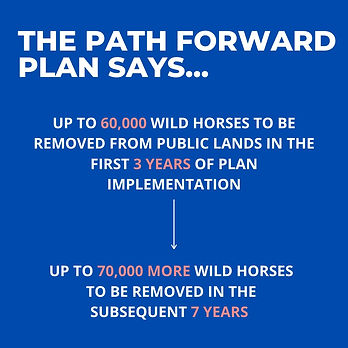
In a nutshell, this diagram (AWHC, 2020) illustrates The Path Forward's plan. If you do the math, that's 130,000 wild horses and burros removed from OUR public lands over the next ten years.
Remember, the current wild horse/burro population is less than 81,000. So, BLM wants to take more wild horses/burros than exist!
This is equicide, which means the willful extermination of all wild horses and burros on OUR public lands.
Which side will you support? Which way do you want to go down in history? Supporting darkness (lies) through indifference and inaction, or rising to the light (truth) through pro-action?

Table 6.


Craig C. Downer, a wildlife ecologist who actually worked with Wild Horse Annie (Velma Johnston) with the implementation of the Wild-Free Roaming Horses and Burros Act (WFHBA) considers The Path Forward a wipeout plan because it wipes out generations of natural adaptation to the particular ecosystems from which these equines came.
According to Downer (2021), basically "natural selection" is being replaced by human's "artificial selection" of who remains and who doesn't, of who reproduces and who doesn't, which is entirely contrary to the true intent of the Wild Free-Roaming Horses and Burros Act (WFHBA).
https://www.horsetalk.co.nz/2021/08/22/outrageous-treatment-americas-wild-horses-habitat/
Craig C. Downer has proposed a naturalistic approach which is ecologically balanced (2021).
-
The Bureau of Land Management (BLM), the US Forest Service (USFS), the U.S. Geological Survey (USGS) (Stade, 2021, p. 1), etc., have unjustly targeted, blamed, and scapegoated wild horses and burros when the real culprits are special interest groups: cattle and sheep ranchers, the hunting establishment, agribusiness, developers who pump down water tables, mining and energy companies whose excesses are protected by the grossly antiquated 1872 Mining Law and that squander and poison vast quantities of precious water throughout the largely arid West.
-
Since the BLM and USFS largely cater to special interest groups, they are in no position to properly manage and carry out the charged tasks of the Wild Free-Roaming Horses and Burros Act (WFHBA).
-
Instead, a separate agency staffed with unbiased and impartial professional wildlife biologists and ecologists, and pro-wild horse-and-burro advocates (in positions of authority), should manage them and their Herd Management Areas (HMAs).
-
Such reform will require the American people to rise up and insist on new legislation for the protection of OUR nation's wild horses and burros.
-
It is clear that the Wild Free-Roaming Horses and Burros Act has been completely dismantled by special interest groups and lobbyists.
-
Thus, it is time to reformulate a new act for the deserved protection of wild horses and burros on OUR public lands NOW.
-
One that has a naturalistic approach and is ecologically balanced.
-
For example, Herd Management Areas (HMAs) should not be over-fenced and cross-fenced in order to restrict the natural movement patterns of wild equids.
-
This is very much contrary to the true and core intent of the WFHBA, which mandates their "free-roaming" lifestyles and allows them to practice their instinctual, natural rest rotation.
-
In addition, both cattle and sheep are invasive species and should NOT be allowed to over graze on OUR public lands subsidized by OUR hard earned taxpayer dollars.
-
Furthermore, 80% of the forage is currently allocated to livestock, whereas only 10-15% (and sometimes even less), is allocated to wild horses and burros in their specified areas, herd management areas (HMAs).
-
With regard to water, both BLM and USFS fail to fend for adequate water for wild horse and burro herds.
-
Instead, they allow special interest groups: ranchers, miners, developers, energy companies, etc., to monopolize the water of HMA territories for their own purposes.
-
This has become apparent to Craig C. Downer during many photographic monitoring flights over HMAs in several Western states with the help of the LightHawk organization.
-
BLM's large-scale and excessive removal of America's last remaining, underpopulated wild horses and burros is actually having a detrimental effect upon the ecosystems they inhabit.
-
Many of these negative effects have already been discussed (see Table 5.), but there are others.
-
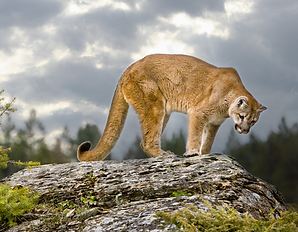
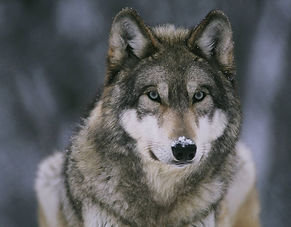
For example, according to the American Wild Horse Conservation (AWHC), BLM spends $120 million of OUR tax dollars on predator control to protect their livestock. As a result, millions of our nation's natural predators (coyotes, wolves, bears, mountain lions, etc.,) are decimated, creating an imbalanced ecosystem.
-
In 2018, Wildlife Services, an agency under the US Department of Agriculture, killed 2.6 million animals, including 375 mountain lions. Furthermore, hunters (with state and federal permits) killed thousands more.
-
Eliminating natural predators to protect livestock in the same area where wild horses and burros roam is counterproductive to wild horse management.
How do wild equids (horses/burros) RESTORE Natural Resources and Ecosystems?
Land Restoration:
Equids restore balance and help heal overgrazed, eroded, and species-poor life communities. Because they are roamers, their broad home ranges result in greater dispersal of many diverse plant species that find a fertile germination bed in equid feces.
Soil:
Equid feces increase the water-retaining abilities of soil because they increase their humus content. This has the beneficial effect of dampening out incipient wildfires caused by lightning strikes, campfire cinders, etc.
Humus is the organic component of soil, formed by the decomposition of leaves and other plant material by soil microorganisms.
Water:
Wild equids wallowing behavior, i.e., rolling on the earth, creates natural water catchments which collect and store water after cloudbursts, rain, and snow storms.
Since the soil has a high clay content in many regions of the West, the water pools are sealed, thus preventing ground water absorption.
As a result, these equid-made water pools can last for weeks to months.
Plants:
The water pools not only provide wild equids and other animals with a source of drinking water, but also facilitate the germination of native plants, such as willows, cottonwood trees, many small flowering plants, sedges, rushes, and grasses of a great variety.
Animals:
These plants provide food for insect pollinators, fruit and seed eaters, stalk and leaf consuming animals, etc. These include rodents, reptiles, rabbits, large mammals and a great variety of birds.
In addition, because of their large, powerful bodies and extensive, frequent movements (as free roamers), wild horses open up thickets and break frozen crusts on lakes for deer (native species) and other smaller, weaker animals.
As one can see, wild horses are a keystone species because they provide a positive cascading effect which mutually benefits their environment and the ecological web in which they inhabit.
Thus, wild equids, through their natural behaviors (roaming, wallowing, opening thickets, and breaking frozen lake crusts ) and water-retaining feces, provide an ECOLOGICAL BALANCE to the land, soil, plants, and animals.
Lastly, because their feces are not fully digested (they have one stomach) their droppings store carbon, rather than releasing.
This sequestering of carbon not only enriches the soil, but also reduces carbon from being released into earth's atmosphere. As you know, carbon dioxide is a major contributor to climate change, in addition to methane, which we have already learned is produced by cattle during the digestive process (burping).
Finally, when wild equids die of natural causes out on the rangeland, their mortal remains contribute once again to the food web, i.e., providing food to their predators: wolves, mountain lions, and bears, as well as scavengers such as foxes, coyotes, and vultures.
This naturalist approach is how it should be out there on OUR public lands, but is sadly and tragically skewed and completely out of balance because of special interest groups' greedy agendas.
https://www.horsetalk.co.nz/2021/08/22/outrageous-treatment-americas-wild-horses-habitat/
Video: The Mustang Man (Craig C. Downer)
We can be heroes, just like Craig C. Downer, and so many others, who dedicate their lives to advocating for the protection of wild horses and burros.
Take Action!
You have the information now to EMPOWER your voice to demand the BLM, President, Senators, Representatives, and Governors to make positive, productive changes on this issue NOW because, "The time is always right to do what's right." MLK
Go to the TAKE ACTION tab today and make a difference!
"Knowing is not enough; we must apply. Willing is not enough; we must do." -Goethe
"Never doubt that a small group of thoughtful, committed citizens can change the world; indeed, it's the only thing that ever has."
-Margaret Mead
Solutions: A balanced approach
A better way (naturalistic approach)





"Animals should not require our permission to live on earth. Animals were given the right to be here long before we arrived." -Gandhi